Fit and colour
Men’s Clothing Size Guide: Shirts, Trousers and Kurta
There is no single size chart for men in India yet. Every brand has its own. Measure yourself once, learn to read body versus garment charts, and you will order the right size from any label.
A size "L" from one brand can fit like an "M" or an "XL" from another. That is not your imagination. Indian brands still use their own size charts because no national standard has yet been widely adopted, as Business Standard reported in July 2026. Online shopping makes the problem worse, since you cannot try before you buy.
The fix is to know your own numbers. Use the measurement helper above to convert between centimetres and inches and to compare your body with a brand's garment measurements. Below, we explain exactly how to measure each body part, how to read any brand chart, and where India's national sizing project stands. For fit advice by garment, see our guides to shirts, trousers, jeans and kurtas.
Before you measure
- Use a soft tailor's tape, not a metal one.
- Wear a thin T-shirt and light trousers, or measure over your vest and underwear.
- Stand straight and relaxed. Do not hold your breath or pull your stomach in.
- Keep the tape level and snug, not tight. You should be able to slide a finger under it.
- Ask someone to help for shoulder, sleeve and back measurements.
- Write every number down in both centimetres and inches; the converter above helps.
How to measure your body, step by step
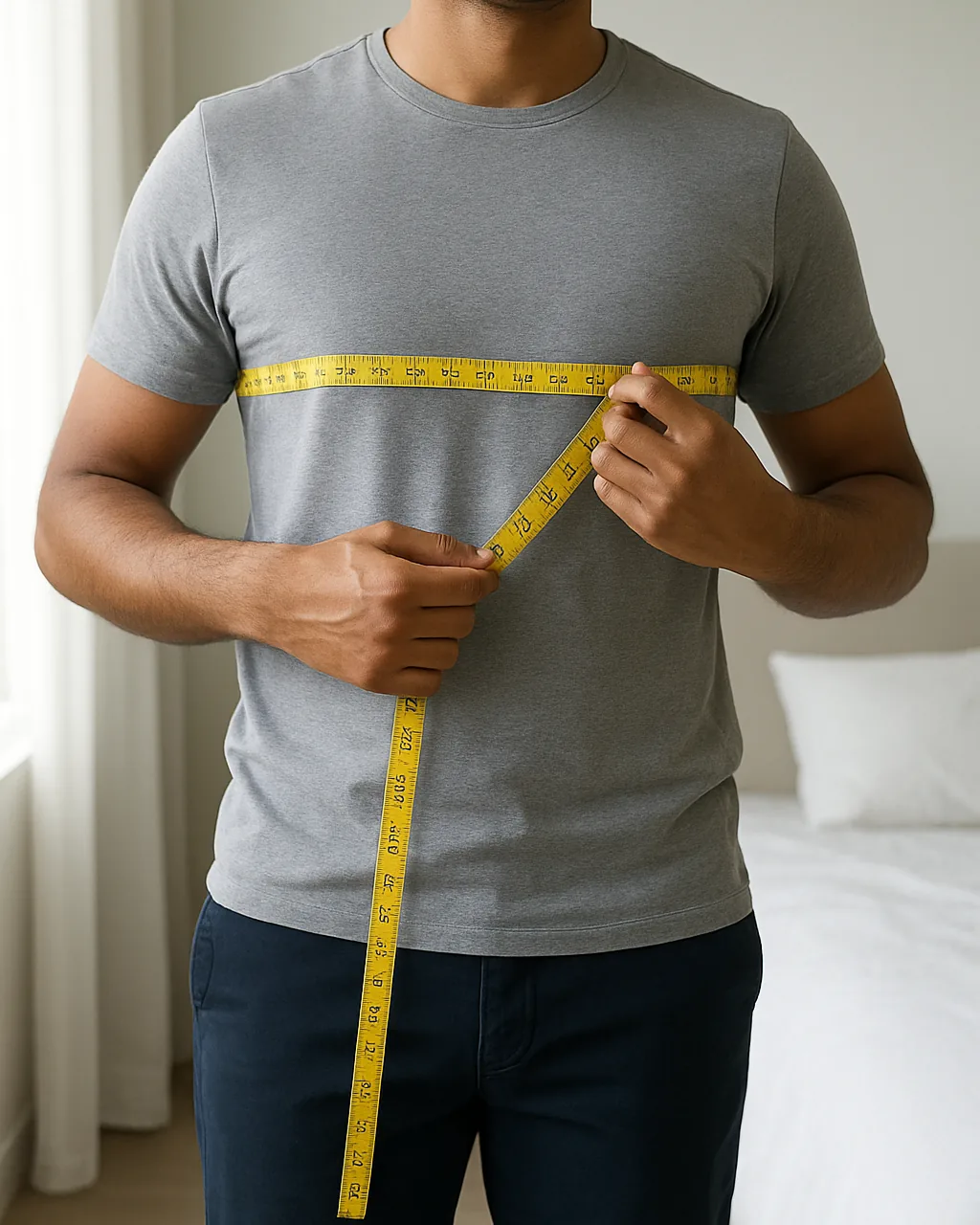
- Chest: wrap the tape under your armpits around the fullest part of your chest, snug, standing normally. This is the main number for shirts, T-shirts, kurtas and jackets.
- Waist (body): measure around your waist at about navel level, with one finger between body and tape. Also note where you actually wear your trousers, because many jeans sit lower.
- Hip or seat: with feet together, measure around the fullest part of your seat.
- Neck: wrap the tape around the lower neck about an inch below the Adam's apple, allowing room for two fingers. Formal shirts are often sized by this number.
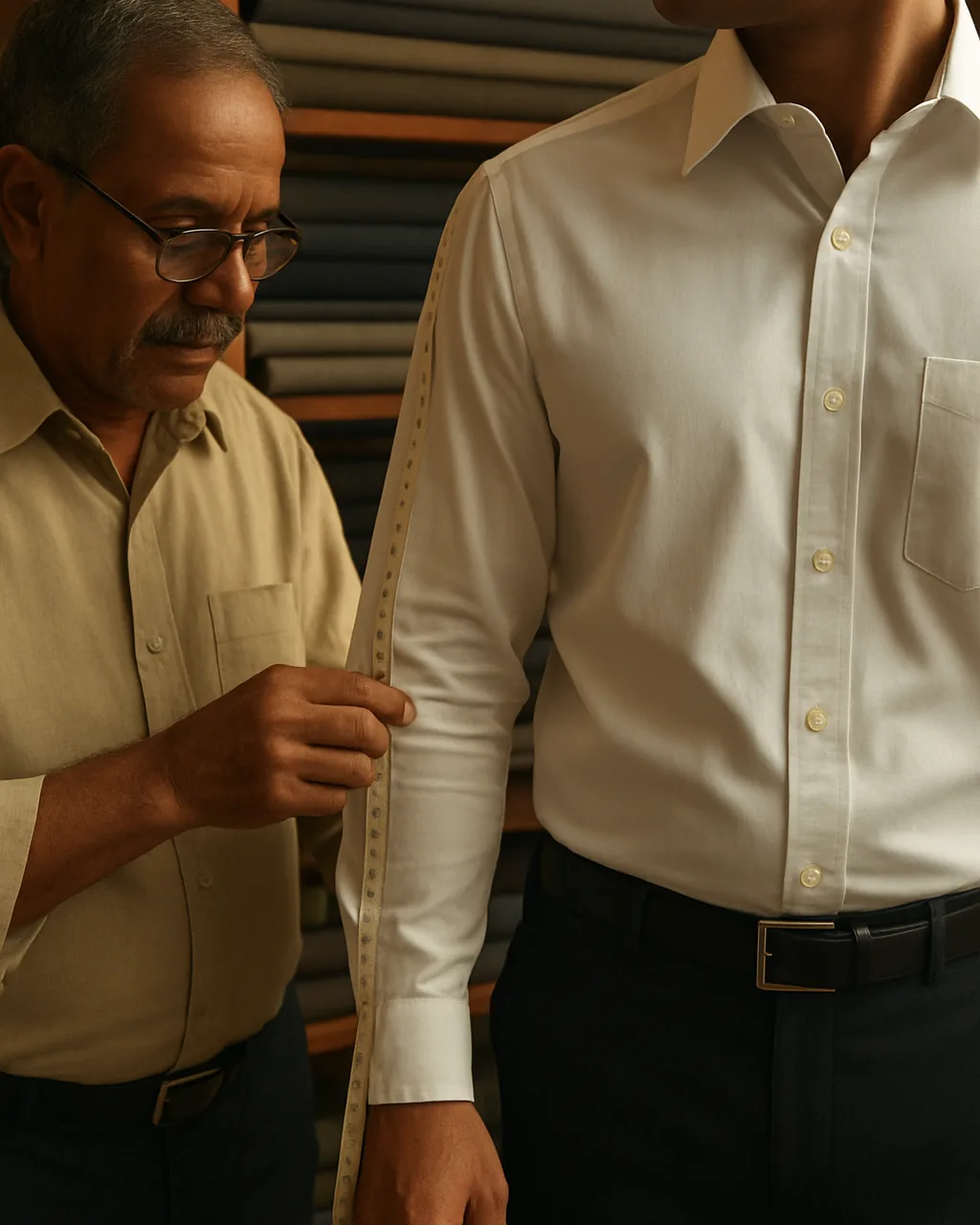
- Sleeve: from the top centre of your back just below the collar, measure to the shoulder point, then to the elbow, then to just above the wrist bone; add the three figures together.
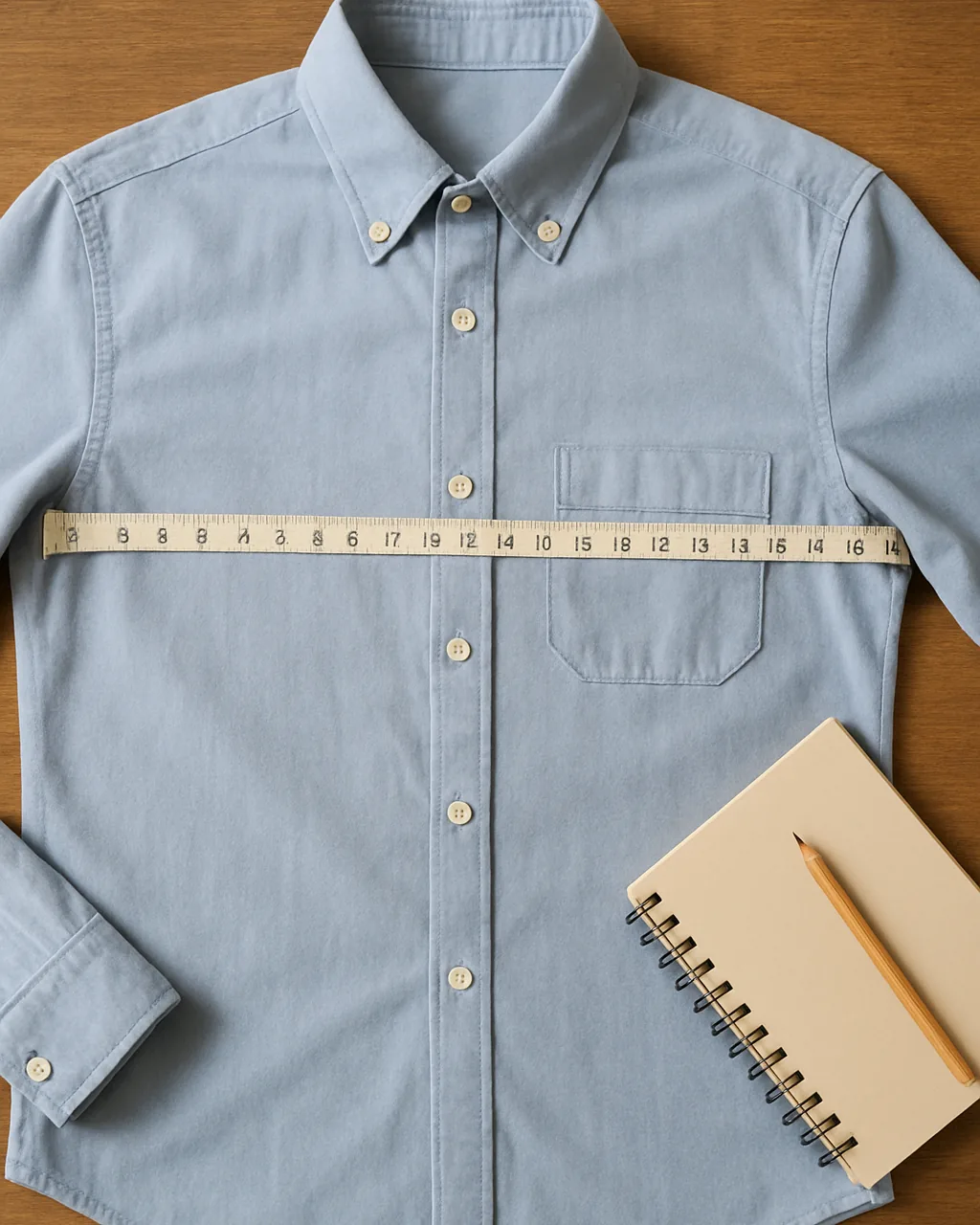
- Shoulder: the easiest way is to lay a buttoned shirt that fits you well face down and measure straight across from shoulder seam to shoulder seam.
- Inseam: shoes off, measure from the lowest part of the crotch down the inner leg to where you want the hem.
- Kurta length: measure from the highest point of the shoulder, next to the neck, straight down to where you want the kurta to end: hip for a short kurta, around the knee for a classic one.
Which measurements matter for each garment
| Garment | Key measurements | Check also |
|---|---|---|
| Formal shirt | Neck, chest | Sleeve, shoulder |
| Casual shirt and T-shirt | Chest | Shoulder, length |
| Kurta | Chest, length | Shoulder, sleeve, hip for straight cuts |
| Formal trousers and chinos | Waist, inseam | Hip, thigh |
| Jeans and cargos | Waist where worn, inseam | Hip, thigh, leg opening |
| Track pants and joggers | Waist, inseam | Hip |
| Blazer and suit jacket | Chest, shoulder | Sleeve, jacket length |
For blazers and suits, a tailor's eye still helps; see our blazer guide and suit guide.
How to read a brand's size chart
Most mistakes happen here, not with the tape.
Body measurement or garment measurement?
A body chart tells you which body chest or waist each size is designed for. If your chest matches the "M" row, order M. A garment chart lists the measurements of the clothing itself, laid flat or measured around. These will always be larger than your body, because clothes need room to move.
Understand ease
The difference between the garment measurement and your body measurement is called ease. A slim fit shirt has little ease; a relaxed or oversized one has a lot. That is what the fit-ease checker above calculates: enter your body chest and the brand's garment chest, and it shows how much room you will have. Compare that with a shirt or tee you already like by measuring it flat.
Flat or full measurement?
Some charts give "chest" as the measurement across the front only (laid flat, pit to pit). Double it to get the full circumference before comparing with your body.
Check the fit name
The same size in slim, regular and relaxed fits will have different garment measurements. Always read the chart for the exact product.
INDIAsize: India's national sizing project
India has been working toward its own size standard based on Indian bodies rather than borrowed foreign charts.
- In February 2018, the government said NIFT would carry out a National Sizing Survey measuring 25,000 men and women aged 15 to 65 with 3D whole-body scanners, to create a size chart for the ready-to-wear industry.
- In February 2019, then Textiles Minister Smriti Irani launched Project "India Size" in Mumbai, covering close to 25,000 consumers in Mumbai, Delhi, Chennai, Hyderabad, Kolkata and Shillong.
- As reported by Business Standard on 30 July 2026, the survey was completed in 2023 and produced 27 body-size charts (14 for men, 13 for women) across three height groups and five body shapes.
- The same report said the charts have been available online for industry use since January 2026, and that the ministry is "close to finalising" a national sizing framework, with discussions leaning toward letter sizes (S, M, L).
What this means for you today: the framework had not been finalised as of that report, and wider brand adoption is still the next step. Until brands adopt a common standard, there is no universal Indian S, M or L. Keep checking each brand's own chart, and look out for brands that start labelling INDIAsize-based sizing.
Common sizing mistakes
- Ordering by habit: "I am always L" only holds within one brand.
- Using a body number on a garment chart: you will end up a size too small.
- Ignoring the fit name: slim, regular and oversized versions of the same size differ a lot.
- Measuring over thick clothes: adds a few centimetres to every number.
- Forgetting shrinkage: cotton and linen can shrink if washed hot; read the care label and keep a little extra ease in pure cotton.
- Skipping the tailor: trousers are usually sold long; hemming is normal, not a sign of a bad fit.
Shoe size and other measurements
For shoes, stand on a sheet of paper in the evening (feet swell during the day), mark your heel and longest toe, and measure the distance. Check that number against the brand's foot-length chart, because UK, US and EU numbering differ and not every brand converts the same way. Measure both feet and use the longer one.
For ethnic wear like sherwanis and bandhgalas, which are more tailored, record your chest, shoulder, sleeve and length, and share them with the store or tailor. See our sherwani guide for occasion wear fitting tips.
Questions men ask
How do I know my shirt size?
Measure your chest around the fullest part, under the armpits, and your neck about an inch below the Adam's apple with room for two fingers. Then open the brand's size chart and match your chest first, and neck second for formal shirts. Check whether the chart lists body or garment measurements before you choose.
Is there a standard size chart for men in India?
Not yet in practice. India's INDIAsize project produced 27 body-size charts, including 14 for men, after a survey completed in 2023, and these have been available to industry since January 2026, as reported. A national framework was still being finalised, so brands continue to use their own charts.
How do I measure my waist size for trousers?
Measure around your waist at about navel level with one finger between your body and the tape. Since many trousers and jeans sit lower, also measure where you normally wear them. Compare these figures with the brand's waist measurement, and check hip and inseam too.
What does L size mean for men?
L means large, but there is no fixed measurement behind it in India. Each brand decides what chest and waist its L fits, so one brand's L can match another's M or XL. Look at the measurements in the brand's chart instead of relying on the letter.
How should I choose a kurta size?
Use your chest measurement as the main guide, then check kurta length, shoulder and sleeve in the brand's chart. Measure length from the top of your shoulder near the neck down to where you want the hem. Straight-cut kurtas also need enough room at the hip.
What is the difference between body and garment measurements?
Body measurements are taken around you with a tape. Garment measurements are taken on the clothing itself and are always larger, because clothes need extra room, called ease. If a chart shows garment measurements, do not compare them directly with your body numbers; allow for the ease.
Sources: Measuring the man (Art of Manliness) · How to measure for a shirt (Charles Tyrwhitt) · National Sizing Survey (PIB, 2018) · Project India Size launch (PIB, 2019) · INDIAsize (NIFT) · India moves towards standard clothing sizes (Business Standard). Updated 14 October 2026.